 Heather Wainer and Lou Weidt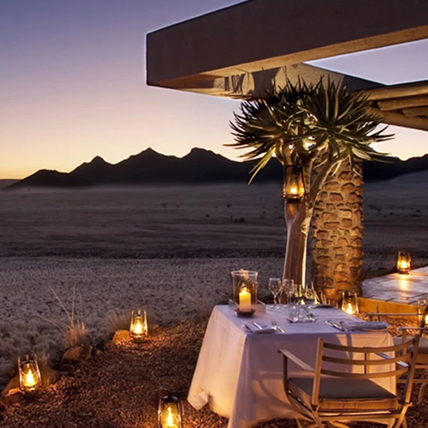
Sample Itinerary
Day 1
ARRIVAL IN WINDHOEK
After landing at Windhoek’s Hosea Kutako International Airport, you will be welcomed by our representative and transferred to The Weinberg, where you will stay in great comfort for your first night in Namibia. Upon arrival at the hotel, you will have time to settle in, relax on your private balcony, or visit the Sky Bar, where panoramic views and tapas await.
Windhoek, Namibia’s capital city, is nestled among rolling hills and bordered by the Eros Mountains to the east, the Auas Mountains to the south, and the Khomas Hochland to the west. It serves as a meeting point between Africa and Europe, and between modern life and historical influences. Along the main street, well-preserved German colonial buildings stand in contrast to contemporary architecture, while Herero women in traditional Victorian-style dress move through the city alongside professionals in modern attire. Centrally located within Namibia, Windhoek is an ideal starting point for an adventurous journey and a convenient base from which to explore the rest of the country.
Overnight The Weinberg
Day 2
FLY FROM WINDHOEK TO NAMIBRAND NATURE RESERVE
This morning you will be collected from the hotel and transferred to Eros Airport, where you will board a scheduled light aircraft flight to the NamibRand Nature Reserve. Fly southwest over the Great Escarpment into the vast Namib Desert below before landing at Sossusvlei Desert Lodge and transferring to the property. Here you will stay for two nights while exploring the remarkable landscapes of the Namib Desert with your lodge guide. If time permits on arrival, you may join an afternoon guided excursion within the NamibRand Nature Reserve as offered by the lodge. After dinner, meet the resident astronomer and make use of the on-site telescope for an evening of remarkable stargazing.
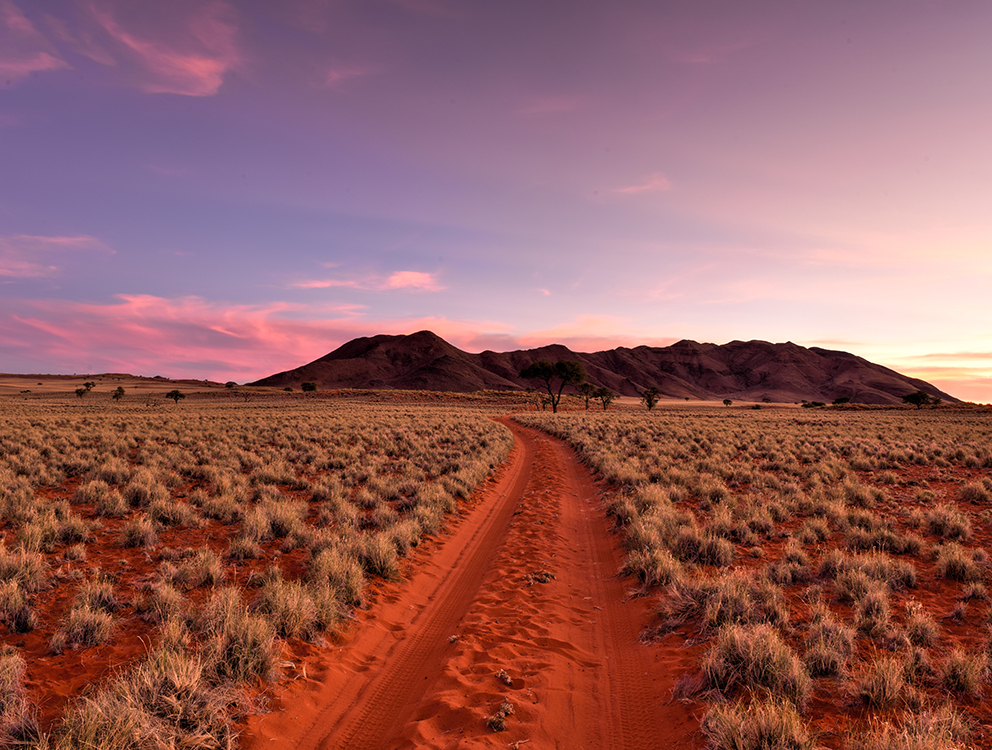
The NamibRand Nature Reserve was established as a conservation initiative in 1984 and now spans more than 180,000 hectares of protected Namib Desert, restoring land previously used for Karakul sheep farming. It shares a long boundary with the Namib-Naukluft National Park to the west, while the Nubib Mountain range forms a natural eastern border. The reserve is known for its diversity of desert environments, including gravel plains, open grasslands, rugged mountains, and sweeping red dune belts, with shifting colors and textures that change throughout the day as light moves across the landscape.
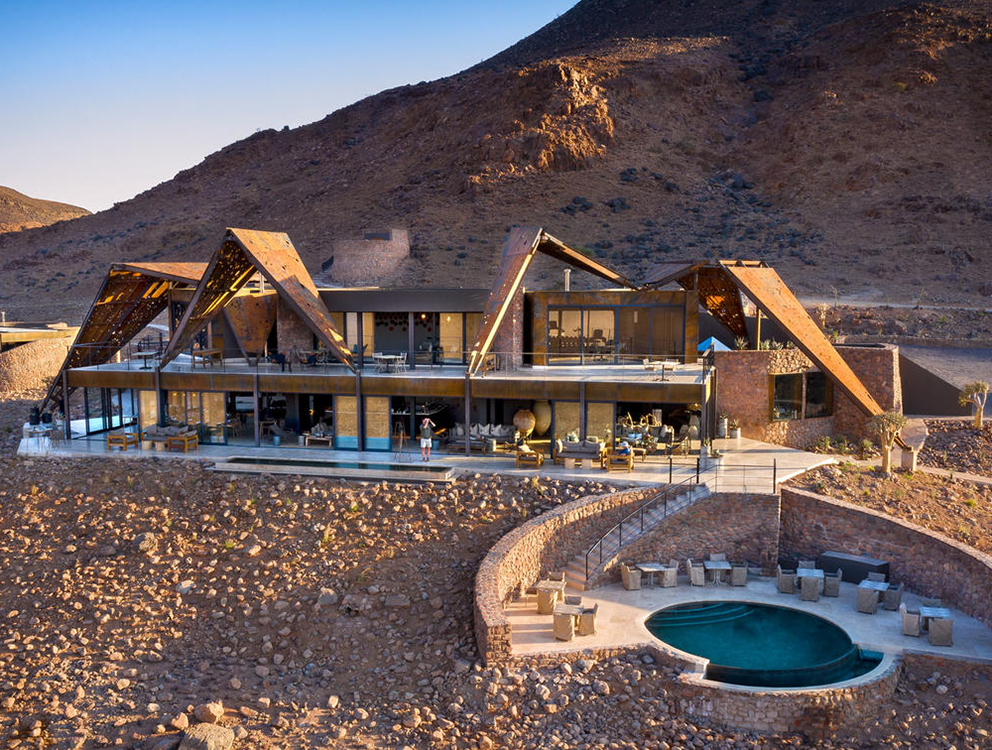
Sossusvlei Desert Lodge, located in the northern part of the NamibRand Nature Reserve, is designed to reflect its surroundings while offering a comfortable and contemporary stay. The lodge is built with stone and glass elements that open toward the surrounding plains, dunes, and distant mountains. Each suite includes a shaded deck, split-level living and sleeping areas with a fireplace, an en-suite bathroom with glass walls, and an outdoor shower. A skylight in each suite allows for night sky viewing, complemented by a central observatory equipped with a powerful telescope. Activities from the lodge include guided 4x4 drives, walking excursions, and quad-biking across the reserve.
Overnight Sossusvlei Desert Lodge
Day 3
SOSSUSVLEI
This morning you will rise early for a guided excursion into the Namib-Naukluft National Park, entering at sunrise to experience the dunes at their most atmospheric, when soft light and long shadows emphasize their sweeping forms. This region is home to some of the highest free-standing sand dunes in the world. Your guide will share insights into the formation of the Namib Desert, along with the remarkable plants and animals that have adapted to survive in this extreme environment. After exploring the area, you will enjoy a picnic breakfast in the shade of a camel thorn tree before returning to Sossusvlei Desert Lodge in the early afternoon, stopping en route at Sesriem Canyon. The remainder of the afternoon is at leisure or may be spent on an additional guided activity offered by the lodge.
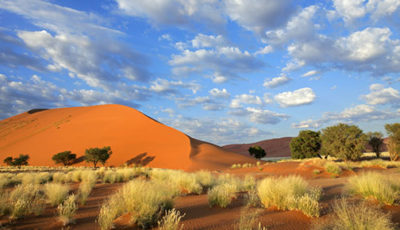
The most visited section of the vast 50,000 km² Namib-Naukluft National Park is known as Sossusvlei, an area defined by its towering apricot-colored dunes accessed via the Tsauchab River valley. Sossusvlei itself is a clay pan surrounded by star-shaped dunes rising up to 300 meters above the surrounding plains, making them among the tallest in the world. The stark white pan contrasts sharply with the surrounding orange sands and marks the terminal point of the ephemeral Tsauchab River, deep within the Namib Sand Sea. The river originates south of the Naukluft Mountains and travels roughly 55 km into the desert before ending at Sossusvlei, though in the distant past it once reached the Atlantic Ocean before shifting dune systems redirected its course. On rare occasions of significant rainfall, the pan fills with water, briefly transforming the landscape and reflecting the surrounding dunes and camel thorn trees.
Sesriem Canyon has been carved over centuries by the Tsauchab River, forming a narrow gorge approximately 1.5 km long and up to 30 meters deep. The canyon exposes layered sedimentary rock formations and provides shaded pools of water that can persist for much of the year. These pools were historically an important water source for early settlers, who used six (SES) lengths of rawhide thongs (riems) tied together to draw water, giving the canyon and surrounding area its name.
Overnight Sossusvlei Desert Lodge
Day 4
FLY FROM SOSSUSVLEI TO DAMARALAND
After breakfast, transfer to the lodge airstrip for a scheduled light aircraft flight into Damaraland, stopping briefly in Swakopmund to refuel before continuing inland. From the air, the landscape shifts dramatically as you approach the heart of the region, where you will spend two nights at Onduli Ridge Camp. You'll have the evening to unwind or take part in a shared activity.
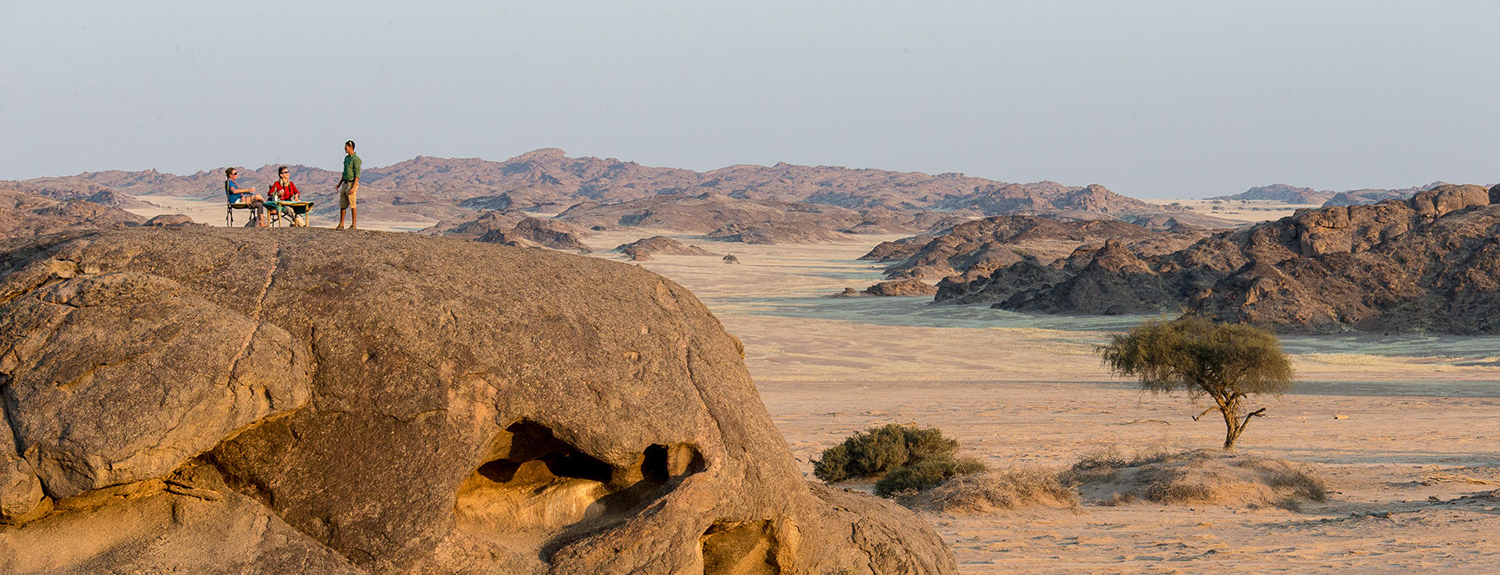
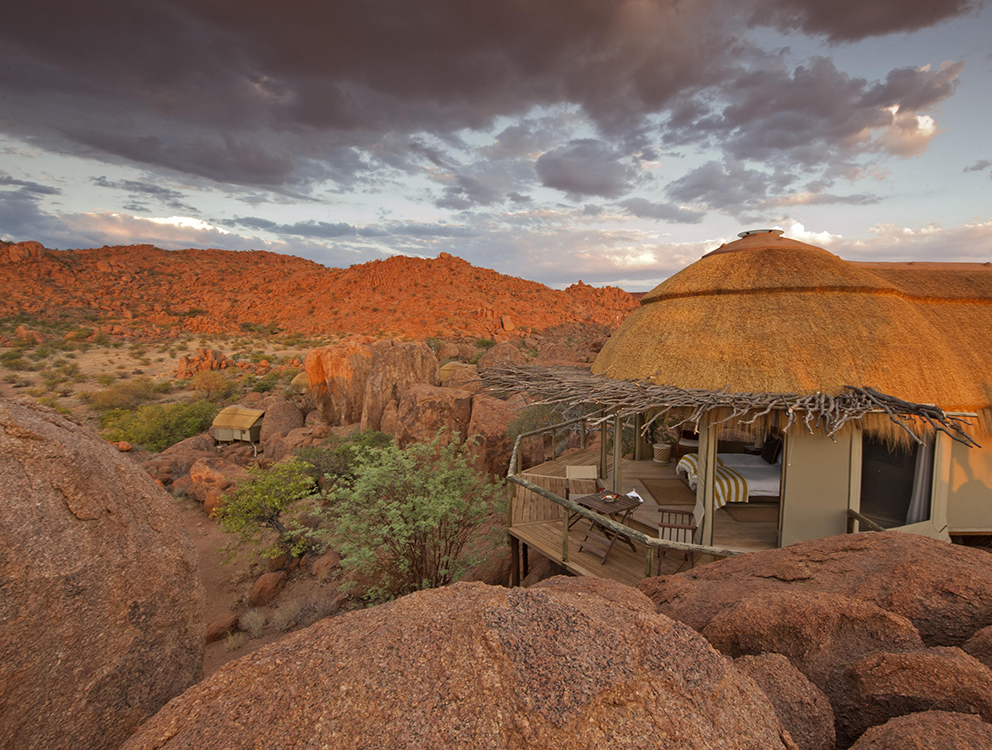
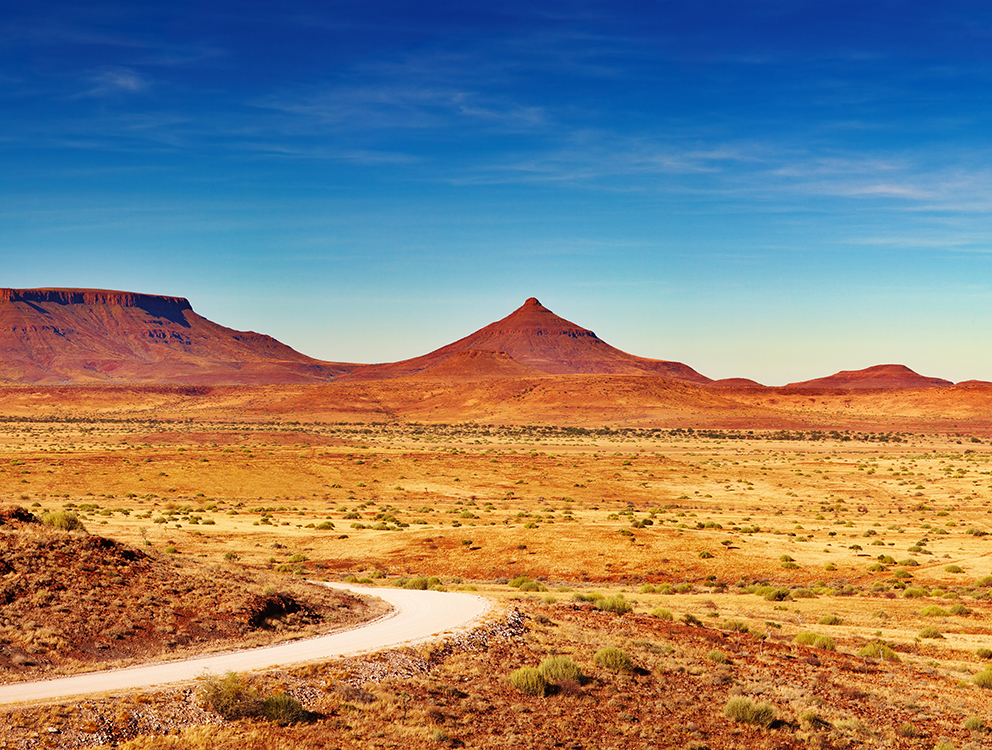
Set at the base of two south-facing granite outcrops linked by a natural rocky ridge, the camp takes its name from the giraffe often seen moving through this part of Damaraland. From here, you look south toward Namibia’s highest peak, the Brandberg, and north across vast plains dotted with cathedral-like granite inselbergs. Onduli Ridge is designed to sit quietly within its surroundings, using stone, canvas, and wood to blend into the rocky terrain. Suites are positioned for privacy and wide desert views, with spacious indoor and outdoor living areas, en-suite bathrooms with rain showers, and shaded decks for time outside. The central area includes a lounge, library, and infinity pool overlooking the desert.
From Onduli Ridge, you will explore the highlights of Damaraland, including Twyfelfontein, Burnt Mountain, and the Organ Pipes. Twyfelfontein is a UNESCO World Heritage Site known for its extensive collection of ancient rock engravings, where guided walks reveal depictions of wildlife, footprints, and abstract symbols created over thousands of years by early hunter-gatherer communities. Nearby, Burnt Mountain and the Organ Pipes showcase striking geological formations, with Burnt Mountain’s dark slopes and shifting colors at sunrise and sunset, and the Organ Pipes’ column-like dolerite structures shaped by ancient volcanic activity and erosion.
Overnight Onduli Ridge
Day 5
Damaraland
After an early breakfast you will be treated to an exciting 4x4 excursion along the ephemeral river valleys to explore this remarkable region and to search for game, including the elusive desert adapted elephants if they are in the area. Damaraland is home to a variety of desert adapted wildlife and hidden desert treasures. As the elephants are mostly active in the mornings, you will normally have the best chance to see them then before returning to camp for lunch. However, you also have the option to take a picnic lunch to enjoy in the shade of a large Ana tree by the riverbed, ideally while watching a herd of elephant browsing nearby.
In areas with adequate vegetation and water, an adult elephant may consume up to 300 kg of forage and around 230 litres of water per day, which quickly adds up when considering the needs of an entire herd over weeks or months. In Damaraland, however, elephants—and other large mammals such as black rhino and giraffe—persist in an environment that at first seems far too arid to support them. Their movements are closely linked to Namibia’s ephemeral river systems, including the Hoanib, Hoarusib, Huab, and Ugab, which form vital corridors through the desert toward regions such as the Skeleton Coast.
These desert-adapted elephants are highly mobile, often traveling up to 68 km between water and feeding areas, with home ranges that can exceed 2,000 km². They typically feed at night, rest during the day, and browse on a wide range of plant species to meet their needs in this harsh environment. They are not a separate species, but a behavioral adaptation to extreme aridity, with only a few comparable populations elsewhere, such as in parts of Mali on the fringes of the Sahara.
It's also possible to arrange a visit to Twyfelfontein and other nearby attractions at a suitable time if you haven’t already done so the previous day. On return to camp there should be time to take a walk into the local area if desired, or simply relax and enjoy some well-deserved leisure time.
Overnight Onduli Ridge
Day 6
FLY TO SKELETON COAST PARK BOUNDARY
This morning you will be transferred to the local airstrip in time for your scheduled light aircraft flight to Hoanib Skeleton Coast Camp. On arrival, you will be met by your lodge guide and transferred along a scenic route to the remote camp, set within one of the most isolated parts of the Kaokoveld. Over the coming days, activities are guided by your local team and may include nature walks, game drives, use of hides, exploratory full-day excursions with picnic lunches, and coastal visits, all focused on the desert-adapted wildlife, plant life, and birdlife of the region.
Hoanib Skeleton Coast Camp is located on the edge of the Skeleton Coast National Park within the Hoanib River concession. This remote corner of the Kaokoveld is defined by dramatic mountains, wide open plains, and dry riverbeds that support a surprising range of life. Despite the arid conditions, desert-adapted elephant, giraffe, antelope, lion, leopard, and cheetah are all found here. The camp itself is small and secluded, with just seven twin-bedded tents and one family unit, offering comfort in a truly remote setting.
While here, you can also explore traces of the region’s early inhabitants, including the Strandlopers, or “beachcombers,” whose stone circles remain hidden in isolated valleys. Other highlights include encounters with ancient Welwitschia plants and time spent following wildlife through vast, uninterrupted desert landscapes that stretch for hundreds of kilometers.
Overnight Hoanib Skeleton Coast Camp
Day 7
SKELETON COAST NATIONAL PARK BOUNDARY
Spend today participating in activities arranged by the camp, exploring this remarkable region with your local guides. Excursions may include game drives in search of desert-adapted wildlife, guided walks to hide platforms and hiking trails, as well as afternoon drives through the surrounding landscape.
Overnight Hoanib Skeleton Coast Camp
Day 8
SKELETON COAST NATIONAL PARK BOUNDARY
This morning after breakfast, you will enjoy a memorable excursion into the Skeleton Coast National Park. You will board a light aircraft for a scenic flight along the coast before landing on the beach. From here, you will continue by safari vehicle to explore this dramatic coastline as arranged by the camp. After a picnic lunch on the beach and further time to explore, you will be flown back to Hoanib Skeleton Coast Camp, arriving with time to relax and enjoy a sundowner.
Overnight Hoanib Skeleton Coast Camp
Day 9
FLY TO ONGAVA RESERVE
After a leisurely breakfast, you will be transferred back to the local airstrip in time for your scheduled light aircraft flight to Little Ongava, located within the Ongava Private Nature Reserve on the southern boundary of Etosha National Park. On arrival, you will be met by a representative from Ongava and transferred to Little Ongava, where you will stay for the next two nights.
Your wildlife experience begins with an afternoon game drive on the private Ongava Game Reserve, as arranged by the lodge, returning in time for dinner. The remainder of the evening can be spent watching wildlife move through the lodge’s floodlit waterhole, which offers constant activity in the hours after dark.
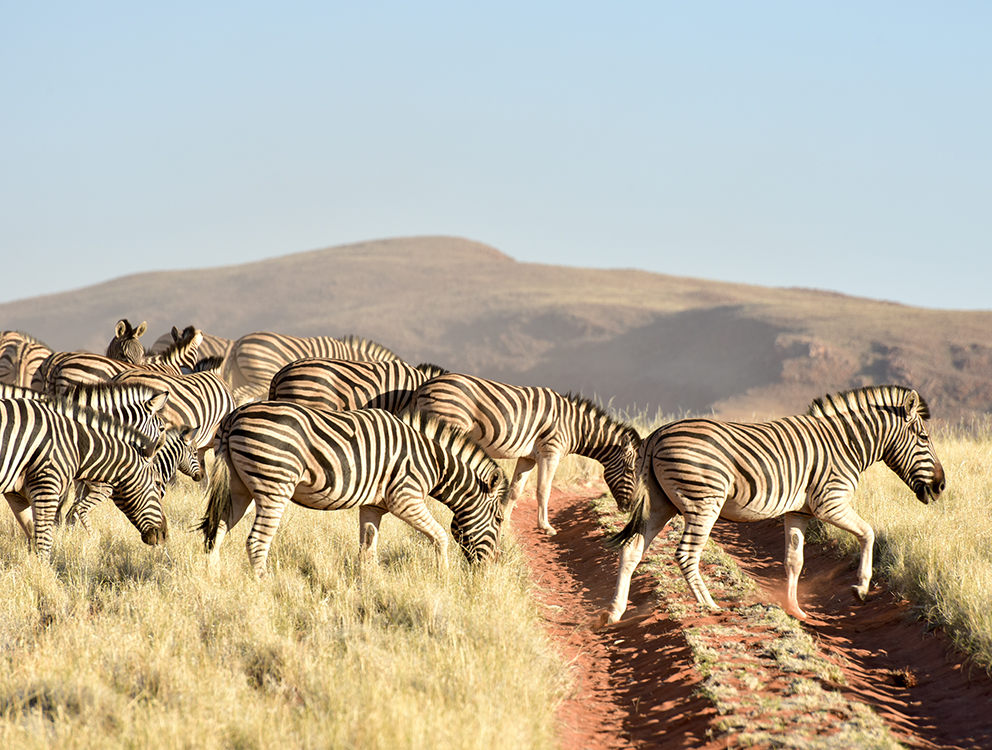
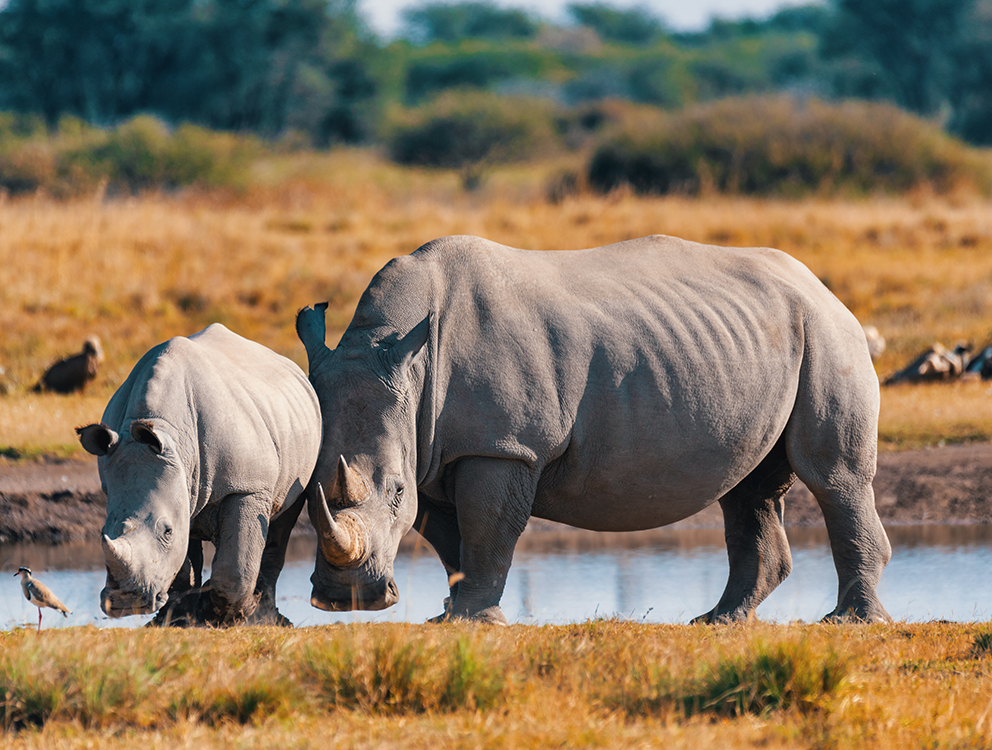
The Ongava Game Reserve spans approximately 30,000 hectares along the southwestern edge of Etosha National Park and supports a wide range of wildlife, including lion, leopard, giraffe, both black and white rhino, Hartmann’s mountain zebra, gemsbok, kudu, and steenbok. The landscape is made up of open plains, mopane woodland, and granite outcrops, creating varied habitats across the reserve.
Little Ongava is set on a rocky ridge within the private reserve, overlooking sweeping views of the surrounding plains and hills. The lodge offers just three private suites, each with a plunge pool, en-suite bathroom, outdoor shower, and shaded sala for relaxing outdoors. The main dining and lounge area overlooks the waterhole below, providing a setting for relaxed dining and wildlife viewing. Activities include game drives, guided walks, and visits to hides overlooking the waterhole, all led by a dedicated guide in a shared vehicle for guests of the lodge.
Overnight Little Ongava
Day 10
ETOSHA NATIONAL PARK
Today you will enjoy a guided morning game drive into the southwestern section of Etosha National Park, returning to Little Ongava for a late lunch and time to relax by your private pool and shaded sala before heading out again for an afternoon game drive on the Ongava Private Reserve.
Etosha National Park covers 22,270 km², of which around 5,000 km² is made up of saline depressions known as pans. The largest, the Etosha Pan, is effectively a saline desert in its own right and lies within the Owambo Basin on the northwestern edge of the Namibian Kalahari. Millions of years ago, this basin formed part of a vast inland lake, which gradually dried after the Kunene River changed course to flow west toward the Atlantic Ocean. In its ancient form, the lake would have ranked among the largest in the world. Today, Etosha Pan fills only intermittently, when seasonal rains in Angola feed the Cuvelai drainage system and send water southward into the basin.
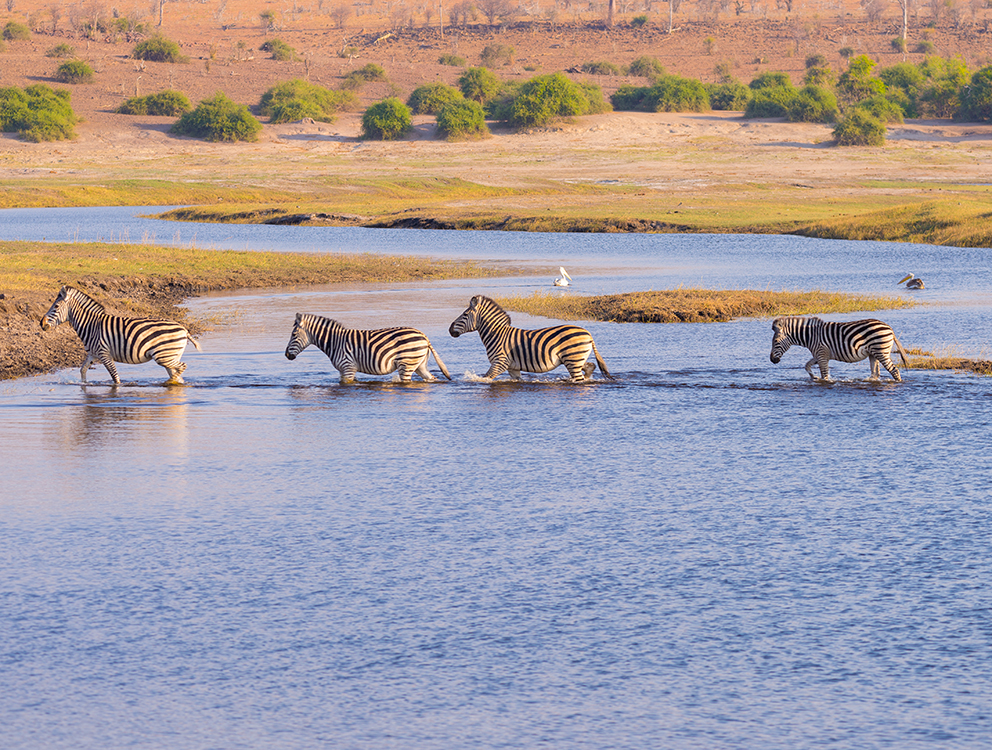
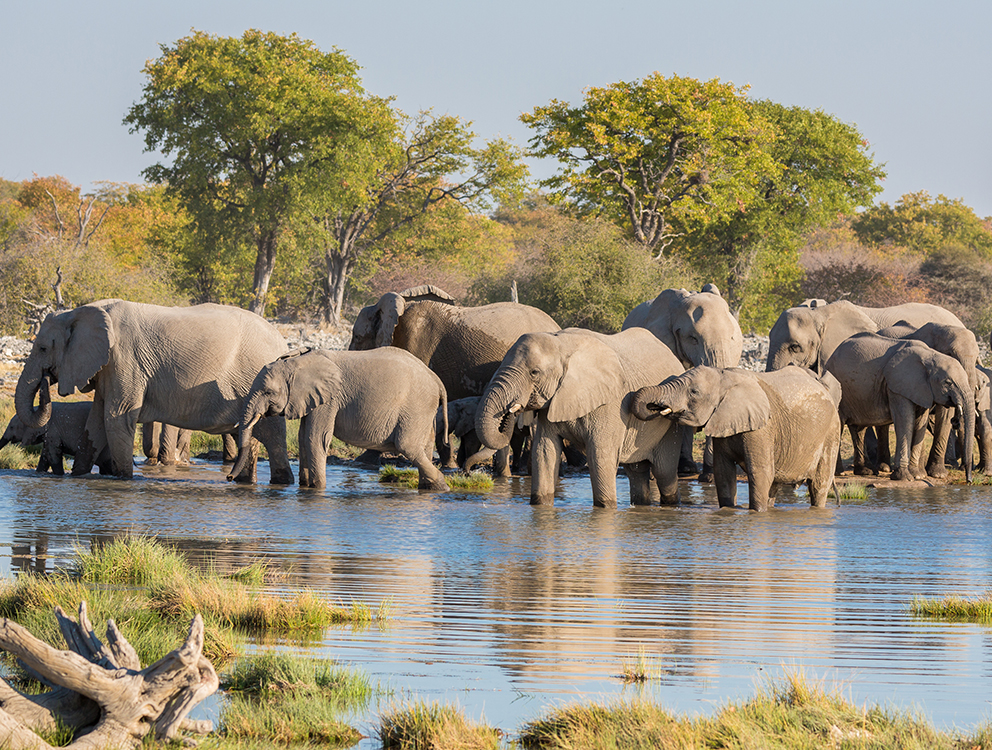
The park is a mosaic of grassland, woodland, and savannah, with wildlife viewing centred around natural springs and waterholes where multiple species often gather together. Etosha is home to more than 114 mammal species and over 340 bird species. Common sightings include elephant, lion, giraffe, wildebeest, eland, kudu, gemsbok, zebra, rhino, cheetah, leopard, hyena, honey badger, and warthog, along with the endemic black-faced impala.
Overnight Little Ongava
Day 11
Fly to Windhoek
This morning, after breakfast, you will have some time to relax and explore the local area before your guide transfers you to the local airstrip for your scheduled light aircraft flight to Eros Airport in Windhoek. You will fly in a south-eastern direction, stopping en route to refuel before continuing on to the capital. On arrival at Eros Airport, you will be met by a representative and transferred to The Weinberg for your final night in Windhoek. The remainder of the afternoon is at leisure.
Overnight The Weinberg
Day 12
Departure
This morning you be will collected from the Weinberg and transferred to the international airport in time for you to catch your flight back home.